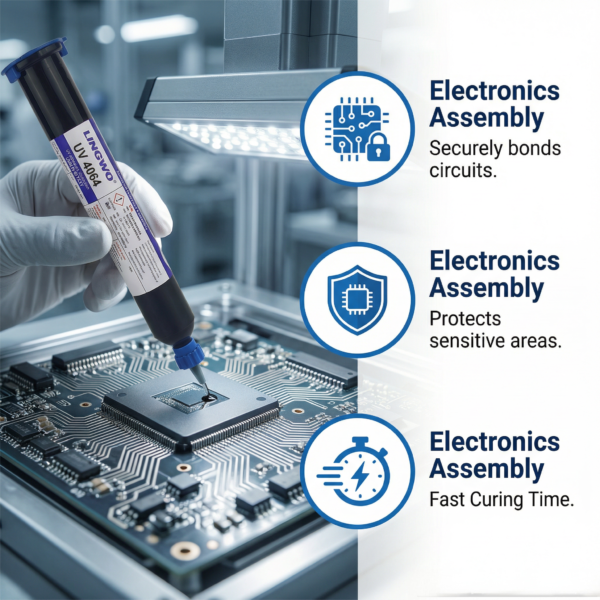
With the surging demand for precision optical components in fields such as consumer electronics, medical imaging, and autonomous driving, traditional mechanical fixation methods can no longer meet the dual requirements of miniaturization and high performance. Recently, a breakthrough has emerged in the global materials science field—the development and application of high-precision optical adhesives, which are quietly rewriting the manufacturing rules for optoelectronic components. These innovations provide lighter, thinner, and more reliable solutions for devices like AR glasses, endoscopes, and LiDAR systems.
How does glue “bond” the future of optics?
Under a microscope, a smartphone camera module may consist of 5-8 stacked lenses, and these nanoscale optical components are not connected by screws or clips but by optical adhesives just a few micrometers thick. This specialized adhesive must meet stringent requirements: a refractive index perfectly matched to glass/plastic substrates to minimize light loss, zero bubbles after curing, resistance to extreme temperatures ranging from -40°C to 120°C, and the ability to withstand environmental challenges such as moisture and chemical corrosion.
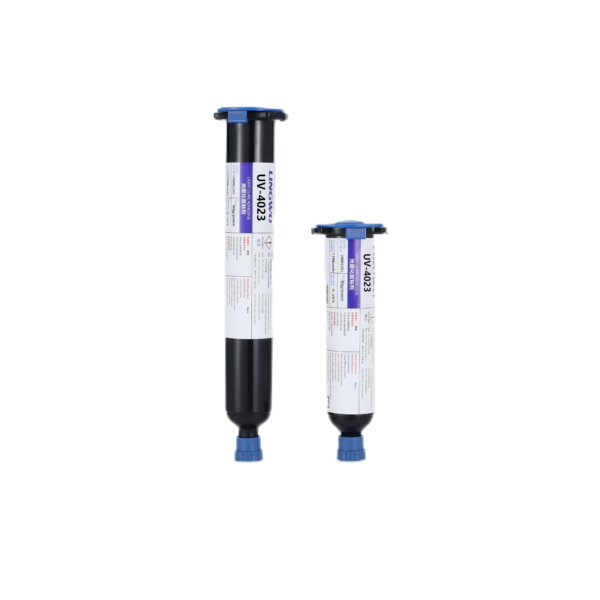
Lingwo’s UV-curable adhesive series, developed by Shuangzhan Industrial, features a curing time controllable within 5-10 seconds, shear strength exceeding 20MPa, while maintaining a 99.9% light transmittance. An engineer from a major international manufacturer revealed: “After adopting the bonding process, the thickness of AR glasses lenses was reduced by 40%, and mass production yield improved by 15%.”. ”
From Healthcare to Quantum Communication: The Explosion of Cross-Disciplinary Applications
In the medical field, optical adhesives are driving a revolution in endoscopy. A medical device company employs low-temperature curing adhesives to seamlessly integrate 1mm-diameter micro lenses with optical fibers, tripling the clarity of surgical imaging. Meanwhile, in cutting-edge technology, quantum communication devices rely on adhesives to precisely fix photonic chips, with assembly errors requiring control within 0.1 micrometers—equivalent to one-thousandth of a human hair.

Market data shows that the global optical adhesive market reached $4.7 billion in 2023, with projections indicating it will exceed $12 billion by 2030, achieving a compound annual growth rate of 14.2%. Chinese adhesive manufacturers are also accelerating their expansion, with their high-temperature resistant epoxy adhesives now used in satellite optical payloads, enabling space telescopes to maintain stable imaging under extreme temperature variations.
Technological Breakthrough: Refractive Index “Invisibility” and Environmental Challenges
The core challenge faced by developers is “making the adhesive disappear at the optical level.” A laboratory achieved dynamic adjustment of the adhesive’s refractive index to the range of 1.46-1.68 using nano-silica doping technology, covering the entire material spectrum from calcium fluoride to polycarbonate. However, environmental regulations are driving industry transformation, with the EU REACH regulation mandating the phase-out of optical adhesives containing over 50% benzene rings. The race to develop bio-based acrylate adhesives has quietly begun.

expert opinion
“Optical adhesive has evolved from an auxiliary material to a core component,” noted Li Mingzhe, a researcher at the International Society for Optical Engineering (SPIE). “The next generation of adhesives may integrate photosensitive properties, directly participating in optical path control, which requires deep interdisciplinary integration of chemistry, optics, and AI simulation.”. ”
Conclusion
When a single drop of glue becomes the key to determining optical path precision, the hidden value of materials science is being redefined. In the foreseeable future, these “microscopic adhesives” may serve as the technological fulcrum driving the trillion-dollar optoelectronic industry.