The demand for lightweight and reliability drives the innovation of adhesive technology, ushering in a “bonding revolution” in the drone industry
[Introduction]
In today’s rapidly developing drone industry, people are often amazed by its intelligent flight, high-definition image transmission, or precise obstacle avoidance technology, but rarely pay attention to a seemingly ordinary role – glue. From the reinforcement of carbon fiber robotic arms to the bonding of gimbal shock-absorbing balls, from the sealing of high-temperature motors to the waterproof treatment of sensors, adhesive technology is becoming an indispensable “invisible hero” in the design and manufacturing of drones. As the industry’s demand for lightweight, durability, and production efficiency upgrades, how can glue help drones fly higher and more stably? This article will delve into the “adhesive revolution”.
1、 Lightweight demand drives innovation in structural adhesives
One of the core performance indicators of drones is the “thrust to weight ratio”, which refers to the balance between power and weight. Traditional screw connections can increase the weight of the body and cause stress concentration, while the application of structural adhesives (such as epoxy resin and polyurethane adhesive) can reduce mechanical fasteners by 30% and evenly distribute loads. For example:
The folding arm of DJI Mavic 3 adopts high-strength carbon fiber adhesive, which improves impact resistance while reducing weight;
The composite body of the Swiss WingtraOne surveying drone achieves seamless aerodynamic shape through adhesive bonding technology, reducing flight resistance.
The relevant international adhesive giant stated that drone manufacturers have higher requirements for the strength to weight ratio of adhesives than the automotive industry, which drives us to develop nano modified adhesives with densities below 1.0g/cm ³. ”
2、 Reliability challenges in extreme environments
Drones need to cope with complex environments such as high altitude and low temperature, high motor temperature (>80 ℃), and humid salt spray, which puts strict requirements on the temperature resistance, aging resistance, and conductivity safety of adhesives
The obstacle avoidance sensor bracket of Skydio 2+in the United States uses flexible silicone to alleviate the impact of vibration on precision optical components;
The electronic cabin of Türkiye Bayraktar TB2 military UAV is sealed with polysulfide glue to prevent dust intrusion;
The Chinese pterosaur series uses ceramic based adhesives that can withstand 300 ℃ in the engine area, replacing some welding processes.
According to Grand View Research, a global market research firm, the annual growth rate of the drone specific adhesive market is expected to reach 12.5% from 2023 to 2030, with the largest increase in demand for high-temperature resistant adhesives.
3、 Intelligent Production and Environmental Protection Trends
With the expansion of drone mass production scale (such as DJI’s annual production capacity exceeding one million units), automated glue coating equipment and fast curing materials for adhesive technology have become the key to cost reduction and efficiency improvement:
Fisnar from Germany has launched a high-precision glue dispensing robot that can complete the bottom filling glue coating of flight control chips within 0.1 seconds;
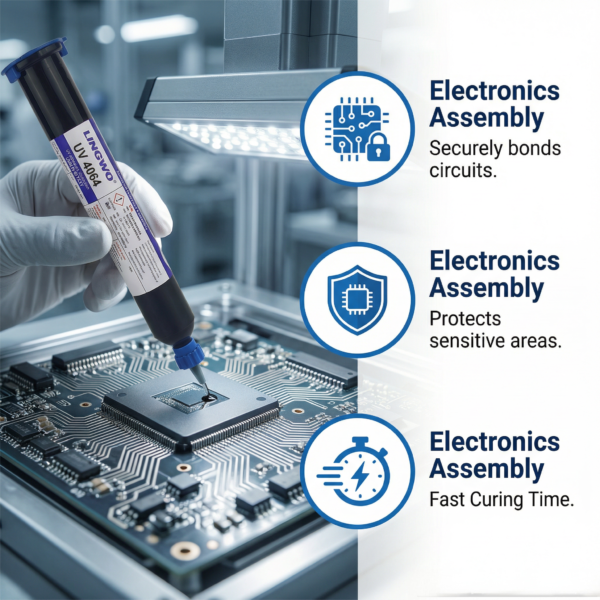
LINGWO develops UV curable adhesive that can bond carbon fiber to metal within 5 seconds, improving production line speed.
In addition, the EU’s “Green Aviation” policy requires adhesives to comply with RoHS heavy metal free standards, bio based epoxy adhesives, etc.
4、 Enterprise case: How glue solves industry pain points
1. The problem of weight reduction for logistics drones
Zipline’s medical supplies delivery drone uses 3M technology ™ VHB ™ Double sided tape fixes the battery pack, reducing weight by 15% compared to bolts and increasing single use range by 20 kilometers.
2. Anti corrosion requirements for agricultural drones
XAG Technology has sprayed polytetrafluoroethylene (PTFE) coating adhesive on the inner wall of the spraying drone medicine box, which increases the pesticide corrosion resistance life by three times.
5、 Future outlook: From “stickiness” to “intelligence”
The next generation of glue may integrate more functions:
Self repairing adhesive: automatically repairs cracks after minor collisions with drones (such as DCPD microcapsule adhesive developed by MIT);
Conductive adhesive: replaces welding and directly prints circuits (Hanyang University in South Korea has achieved 5G antenna bonding);
Reversible adhesive: enables quick disassembly and replacement of components, reducing maintenance costs (such as photo thermal responsive adhesives).
Expert Opinion
Adhesive technology is redefining the design boundaries of drones, “said David Benowitz, Technical Director of the International Unmanned Aerial Vehicle Association (AUVSI).” In the future, adhesive will not only be a connecting material, but also an important carrier for the intelligence and sustainability of drones
【 Conclusion 】
Every moment when a drone flies to an altitude of tens of thousands of meters, delves into disaster sites, and crosses agricultural canyons, it cannot do without a drop of “inconspicuous” glue behind it. From consumer level to military level, this quiet “glue revolution” is using the power of technology to lift humanity’s infinite imagination of the sky.
About Lingwo Group
Lingwo was established in 2013, focusing on the research and development, production, and sales of environmentally friendly adhesives (UV glue, epoxy glue, acrylic structural glue, instant drying glue, organic silicone glue, polyurethane glue, etc.). Our products cover three major series: industrial, civilian, and specialty adhesives, serving well-known enterprises in over ten countries worldwide. The company always adheres to the concept of “bonding everything, bonding responsibility” and is committed to providing green solutions for the industry.