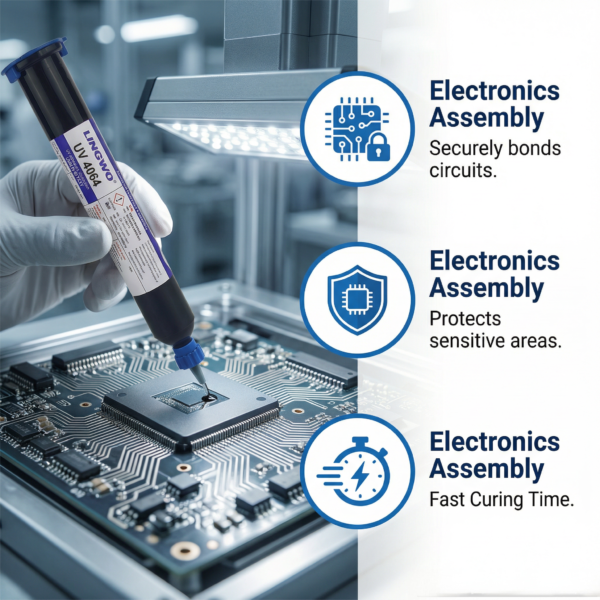
In the pursuit of more precise, safer, and more reliable medical devices, a seemingly minor technology—UV (ultraviolet)-curable adhesives—is quietly becoming a core driver in the manufacturing of high-end medical components. From minimally invasive surgical instruments to precision diagnostic equipment, and from implantable sensors to disposable consumables, UV-curable adhesives are redefining the design and production standards for medical parts with their unique performance advantages.
Enables Precision Bonding, Meeting Stringent Medical Demands:
- Instant Curing, High Efficiency & Reliability:Eliminating the long wait times of traditional adhesives. UV-curable adhesives achieve full curing within seconds under specific wavelengths of ultraviolet light, significantly boosting production line efficiency and throughput for medical components, ensuring rapid delivery of critical medical devices.
- Micron-Level Precision, Virtually Stress-Free:As medical components trend towards miniaturization and higher precision, the low viscosity of UV-curable adhesives allows them to easily penetrate microscopic gaps. The curing process generates almost no heat or internal stress, perfectly preventing deformation or damage to delicate optical elements, microelectronic sensors, or brittle biomaterials during bonding.
- Exceptional Sealing, A Safety Barrier:Provides reliable, hermetic seals for critical areas like catheter connectors, sensor housings, and fluid pathways. Effectively isolates against bodily fluids and disinfectants, prevents microbial ingress, and builds a robust defense for patient safety and the long-term stable operation of devices.
- Biocompatibility Certified, Assured Safety:Leading medical-grade UV-curable adhesives strictly comply with international biocompatibility standards such as ISO 10993 and hold authoritative certifications (e.g., FDA). This ensures the safety of the cured material when in contact with human tissue or bodily fluids, meeting the rigorous requirements of various applications, including implant-grade and long-term external contact.
- Superior Environmental Resistance:The cured adhesive layer exhibits excellent chemical stability, withstanding repeated exposure to harsh medical sterilization processes like gamma irradiation and ethylene oxide (EtO), as well as resisting various chemicals in physiological environments, ensuring long-lasting performance.
Empowers Innovation, Drives Medical Device Advancement:
The mature application of UV-curable adhesive technology unlocks unprecedented possibilities for medical device designers:
- Integration of Complex Structures:Enables reliable bonding between irregularly shaped materials and micro-components that are difficult to process using traditional methods, paving the way for lighter, more functionally integrated devices.
- Breakthroughs in Miniaturization:Provides critical bonding solutions for cutting-edge fields like wearable continuous monitoring devices and implantable microelectronic medical devices.
- Enhances Product Yield & Reliability:Fast, controllable, and clean curing processes significantly reduce production defects, improving the overall quality and long-term reliability of medical components.
Industry Outlook:
With the vigorous development of precision medicine and minimally invasive technologies, the demand for high-performance, highly reliable miniaturized medical components will continue to surge. UV-curable adhesive technology, with its unique precision manufacturing capabilities, has become an indispensable cornerstone supporting this trend. Material scientists and manufacturers are dedicated to developing next-generation UV-curable adhesives with superior biocompatibility, stronger bond strength, and compatibility with bonding novel biomaterials, continuously driving high-end medical devices toward safer, smarter, and less invasive solutions.
About UV-Curable Adhesives:
UV-curable adhesives are high-performance bonding agents that rapidly transition from liquid to solid state upon exposure to specific wavelengths of ultraviolet light. They are widely used in high-end manufacturing sectors including medical, electronics, and optics.